
 2 months ago
Mark PoyntingClimate researcher

 Getty Images
The Earth's climate is further out of balance than at any time in recorded history, the UN's weather agency has warned.
The World Meteorological Organization says that our planet is gaining much more heat energy than it can release, driven by emissions of warming gases such as carbon dioxide.
This record "energy imbalance" heated the ocean to new heights last year and continued to melt our planet's ice caps.
And scientists fear that a natural warming phase called El Niño – expected to begin later this year - could soon bring further heat records.
In response to the report, UN Secretary General António Guterres reiterated his call for countries to move away from fossil fuels to renewable energy to "deliver climate security, energy security and national security".
"Planet Earth is being pushed beyond its limits. Every key climate indicator is flashing red," he warned, in a typically punchy video address.
The last 11 years were the Earth's 11 warmest years in records stretching back to 1850, the World Meteorological Organization (WMO) says.
In 2025, global average air temperatures were about 1.43C above those of "pre-industrial" times - before humans started burning large amounts of fossil fuels.
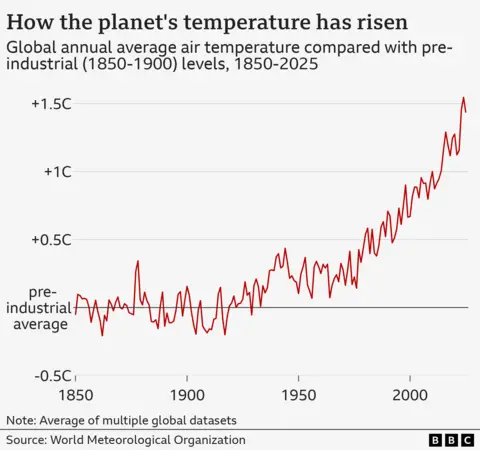
But last year was still one of the three warmest years since records began. Many scientists now believe that warming is accelerating, although they say temperatures are broadly within the range of long-term predictions.
And the WMO points to a wealth of other evidence showing that the climate is changing faster than we have ever seen before.
Perhaps the most comprehensive measure is the amount of extra heat energy being taken up by the Earth.
This "energy imbalance" ultimately drives climate change and reached a new high last year, the WMO says.
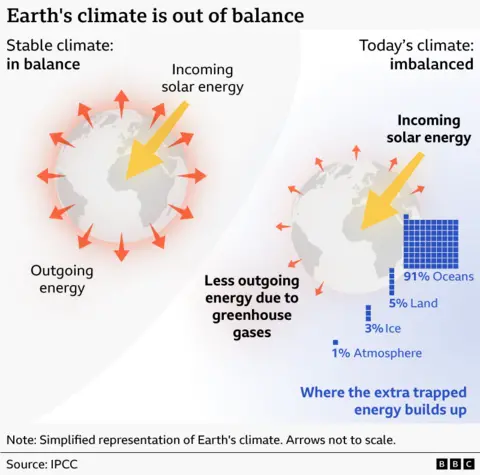
Some of the extra energy trapped by these gases warms the atmosphere and the land, as well as melting the planet's ice.
The world's glaciers had one of their five worst years on record in 2024/25, according to provisional data, while sea ice at both poles was at or near record lows throughout most of 2025.
But more than 90% of the Earth's extra energy heats the oceans, which in turn harms marine life, drives more intense storms and contributes to sea-level rise.
The heat stored in the upper 2km (1.2 miles) of the global ocean reached a new high last year, the WMO says. Over the past two decades, it has been warming more than twice as quickly as during the late 20th Century.
"Human activities are increasingly disrupting the natural equilibrium and we will live with these consequences for hundreds and thousands of years," said Prof Celeste Saulo, secretary general of the WMO.
The report points to the impacts of rising temperatures today, which are helping to intensify many types of extreme weather and aiding the spread of diseases such as dengue.
Rapid analysis by scientists at the World Weather Attribution group on Friday found that intensity of heat would have been "virtually impossible" without human-caused climate change.
Researchers are also closely watching the Pacific Ocean, with long-term forecasts strongly suggesting that a warming El Niño phase could form in the second half of 2026.
An El Niño - on top of the background human-caused warming trend - could push temperatures to new heights into 2027.
"If we transition to El Niño we will see an increase in global temperature again, and potentially to new records" said Dr John Kennedy of the WMO.



